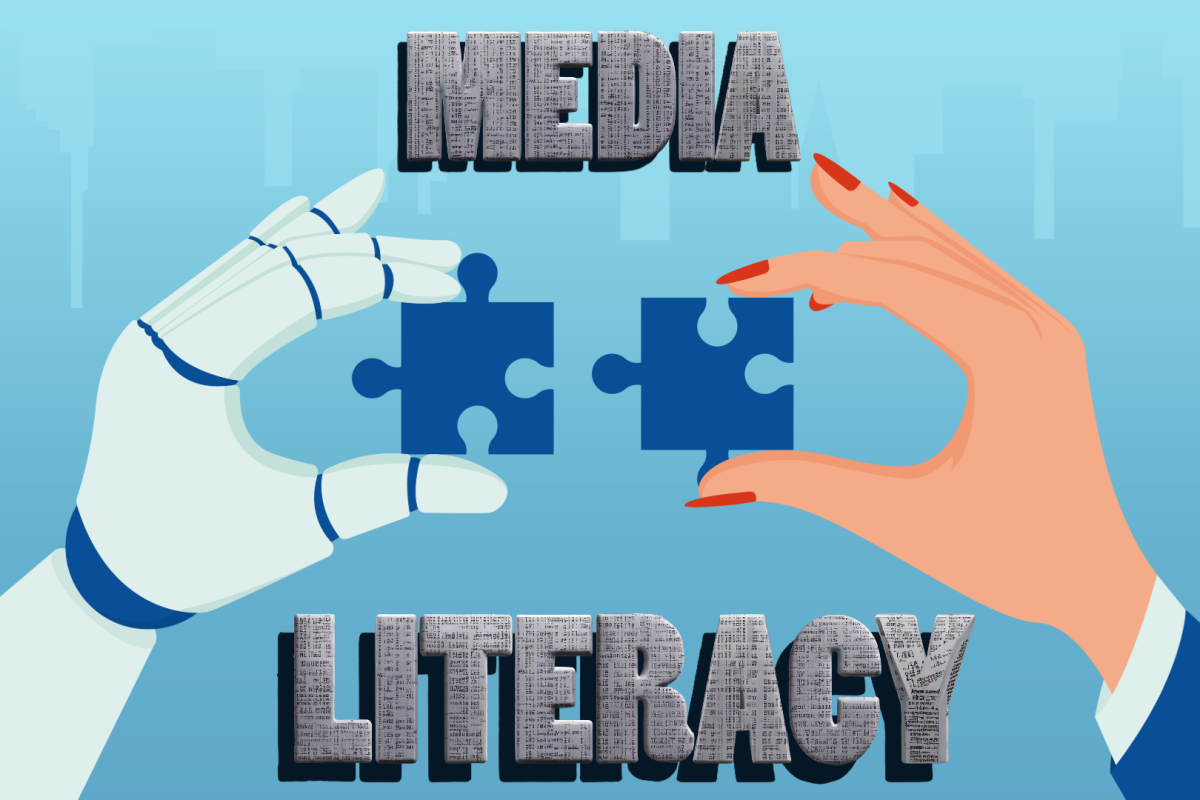
In a world where anyone can publish anything, teenage students are expected to navigate an information landscape more chaotic than any generation before them. Every day, students scroll past headlines crafted by AI, videos edited without labels and influencers paid to push opinions that are not actually their own.
Yet despite the nonstop flood of content shaping how young people think, vote, shop, and understand the world, most high schools still do not teach media literacy in any meaningful or consistent way. The gap is not just outdated; it is dangerous.
Media literacy is defined as the ability to access, analyze, evaluate, create and communicate information across different forms of media, including news articles, social media posts, videos, advertisements, websites and images.
Teachers love to remind students to “check your sources,” but the truth is that superficial advice is not enough anymore. Misinformation no longer looks like messy conspiracy blogs at the bottom of a Google search. It looks like polished Instagram infographics, seemingly informational political TikToks, AI-generated news and deepfake videos capable of fooling millions before fact-checkers can even react. Polls have revealed that America’s trust in mass media has declined to a record low. Without explicit education in how to analyze digital content, today’s students must decode an increasingly deceptive world with tools designed for a different era.
Teaching media literacy is not about telling students what to think, but instead, it is teaching them how to think. When students ask questions like “Who made this?”, “What’s the purpose?”, and “What information is missing?”, they gain the ability to evaluate content with independence and skepticism.
These are skills that spill into every subject, whether it be identifying bias in history in primary sources to understanding how scientific studies can be misrepresented online. Media literacy builds true critical thinking in a way that traditional school curriculums cannot.
It also protects young students from manipulation. Teens are a prime target for algorithm-driven advertising and persuasive content because their feeds are personalized and largely unregulated. Without training, it is easy to confuse sponsored content for authentic recommendations or legitimate expertise. When students understand how platforms shape the information they see, and why, they become less vulnerable to negative digital influences.
Some argue that schools do not have enough time to add another requirement. However, media literacy does not need to exist as a standalone class. It can integrate seamlessly into English, social studies or any other subject offered. It actually serves its purpose more effectively if integrated into the entire school curriculum, as it can become a lens through which students analyze the information they already encounter daily.
Many countries, including Finland and Sweden, have embedded media literacy throughout their curriculum, and they consistently rank among the most information-resistant populations in the world. The United States should not settle for being left behind.
If we want the next generation to participate responsibly in democracy, interpret global events and navigate the digital landscape without being misled, media literacy cannot remain optional. High school students deserve the tools to protect themselves from misinformation and manipulation. The cost of ignorance is too high.