
As students move through middle school and into high school, it is common for participation in sports to decline. What is less commonly discussed is how uneven that decline is. Studies show that girls quit sports at nearly twice the rate of boys during their teenage years, a difference that raises important questions about the environments female athletes experience.
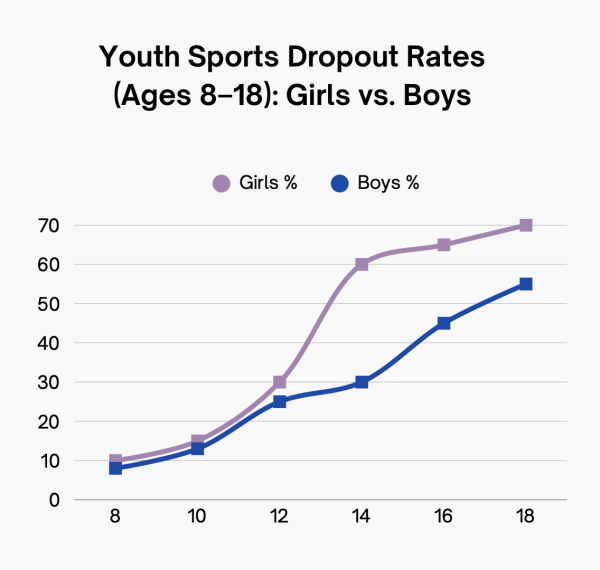
National youth sports participation studies, 2010–2019 (Women’s Sports Foundation).
Sports are often viewed through wins, records, and highlights. However, for many athletes, especially girls, the experience is shaped by much more than competition. Athletics are one of the few spaces where young people are challenged to build confidence, resilience, and discipline in real time. When girls leave sports at such a high rate, it suggests that something deeper is influencing their decision.
One factor is the level of pressure placed on female athletes at a young age. As competition increases, sports can begin to feel less like an activity to enjoy and more like a source of constant stress.
“I quit club soccer when I was younger because it became really stressful,” Raegan Timmons said. “There was so much pressure, and it stopped being enjoyable. I knew I did not want to play in college, and I did not want something that made me feel overwhelmed all the time.”
Environment also plays a major role. Girls are more likely to report leaving sports because of team culture, coaching style, or a lack of support. When the focus shifts entirely to performance, comparison, or expectations, confidence can quickly fade.
“A huge part of why I stopped playing was the environment,” senior Audrey Wurms said. “It affected my confidence and made it hard to enjoy the sport.”
Social pressure adds another layer. During the teenage years, girls are often more aware of how they look and how they are perceived by others. Sports require athletes to make mistakes publicly, accept criticism, and perform under pressure. For some girls, this becomes exhausting rather than empowering, especially when support systems are limited.
This does not mean boys do not experience pressure in sports. They do. However, girls often face additional expectations that sports environments are not always built to support. When those pressures outweigh the positives, participation declines.
The impact of this trend extends beyond athletics. Sports teach skills that carry into adulthood, including leadership, teamwork, accountability, and the ability to work through discomfort. When girls leave sports early, they lose access to one of the strongest environments for developing those skills.
As the participation gap between boys and girls continues to grow, the focus shifts from motivation to structure. Creating environments that emphasize growth, confidence, and enjoyment may be key to keeping girls involved.
Sports are not meant to be easy, but they are meant to help athletes grow. Understanding why girls are leaving, and why it happens at a higher rate than boys, is the first step toward protecting an experience that shapes people far beyond the field.