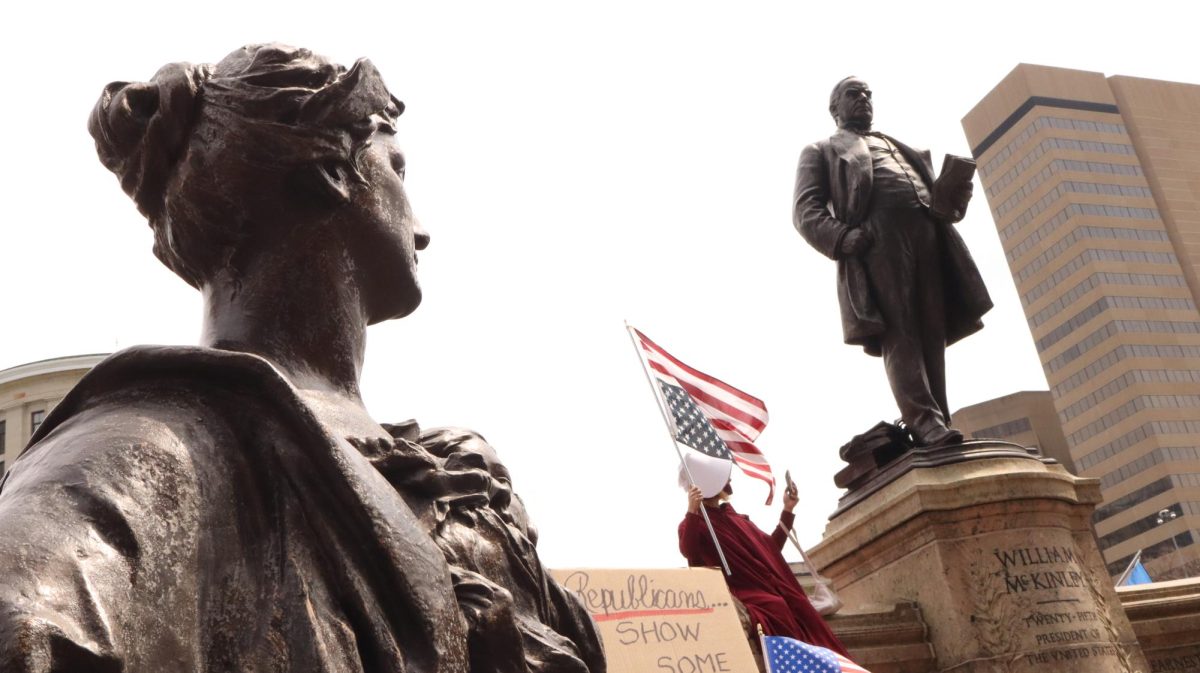
Although it has been said by almost every generation of the past 250 years, right now is possibly the most tumultuous time in American history. There is civil unrest in essentially every aspect of our society, from ICE agents in residential neighborhoods to geopolitical unrest with concerns over the growing conflict in the Middle East. In a country where countless members of the elite (including multiple presidents) are listed in a decade-spanning pedophilic conspiracy, there are going to be conversations, especially between young people, that have to be had.
For most people, these conversations are made on platforms such as X, Instagram, or Threads. All of these social media sites allow people to access a wide variety of different viewpoints, but most of these opinions are quite extreme. According to a study conducted by the NYU Stern Center for Business and Human Rights, social media is the leading source of continuing division, especially in younger populations. As the political climate continues to escalate into a storm of polarized mobs with no intent to actually discuss the issues at hand, it is my belief that there needs to be more grounded locations for political discussion.
Frustratingly, most adults nowadays are too polarized to either the left or the right to allow themselves to engage in meaningful conversations over important (and sometimes uncomfortable) topics. A fifty-year-old conservative from the deep south and a fifty-year-old liberal from New York City have been immersed in the polarizing 24-hour news cycle for at least thirty years, leading them to develop what sociologists call a “mirror-image perception” of the other party, the (seemingly) deeply logical idea that the other side is fundamentally evil and that their side is 100% morally just. These beliefs have led to the stalemate of epic proportions that we are seeing in the news right now.
Of course, the world does not actually work this way. There is no political party in the world that has the correct answer to every single question. The two establishment-level political parties in the United States have billions of dollars running into them from PACs and billionaire donors, making their responses to important issues less than ideal for the common American. Most could agree that this system is morally bankrupt, but there hasn’t been any meaningful action taken towards changing it. This is where I believe the youth comes in.
In the 1960s, youth political movements were at the forefront of American political discussion. The Civil Rights Movement, the Free Speech Movement, and the Anti-War Movement were all on the front lines of positive change that would have otherwise never taken place. John Lewis, the civil rights leader and eventual Congressman, was only 23 years old when he appealed for civil rights at the March on Washington in August of 1963. Tom Hayden, the revolutionary founding member of the Students for a Democratic Society, was only 20 years old when he became involved with political organizing at the University of Michigan. Fred Hampton, the chairman of the Illinois chapter of the Black Panther Party, was only 21 years old when he was assassinated by the Chicago Police Department for his wide involvement in civil rights-related community organizing.
All of these figures created real change, whether it be in civil rights or the formation of the New Left. Of course, these men were in their twenties, a little outside of the age range of the student body at Granville High School. However, to suggest a proportional adjustment of impact is reasonable. No one is expecting a freshman to go out and make a wide-scale impact like these figures, but they should be able to make some kind of difference if they desire to. Currently, there are no outlets for politically opinionated students at GHS, on either the right or the left. The easiest way for any politically active student to get involved is through a school political club.
According to a study conducted by Brookings, 62% of American high schools have after-school political clubs. At these high schools, the most popular clubs include many nationally organized groups, including the High School Democrats of America, the Young Americans Foundation, Turning Point USA, and the Young Democratic Socialists of America. For a student body comprised of over 850 students, not having a single one of these political clubs or a single independent club is honestly pretty outrageous. Almost everyday, I see my peers post politically charged information on their Instagram stories, as this is one of the only manners for a student here at GHS to get their viewpoint seen by their peers. If these students had access to a means to enable their viewpoints, they would feel more empowered in the American political climate.
If students were to want to form a political club at GHS, we would have every right to. Due to the Equal Access Act of 1984, GHS is not able to forbid a student from forming a politically-issued club since they allow the establishment of other clubs. On top of that, student involvement with political issues falls directly in line with Granville’s Portrait of a Graduate initiative, as I would argue that it promotes student collaboration, responsibility, critical thinking skills, and empathy.
Over the course of my four years at Granville High School, I have personally seen seen the intense level of drive within our student body. If this go-getter attitude was grasped by a collection of politically active students, I would be willing to bet there would be some positive changes in our community as a result. Every student here has an opinion, why don’t we do something about them?